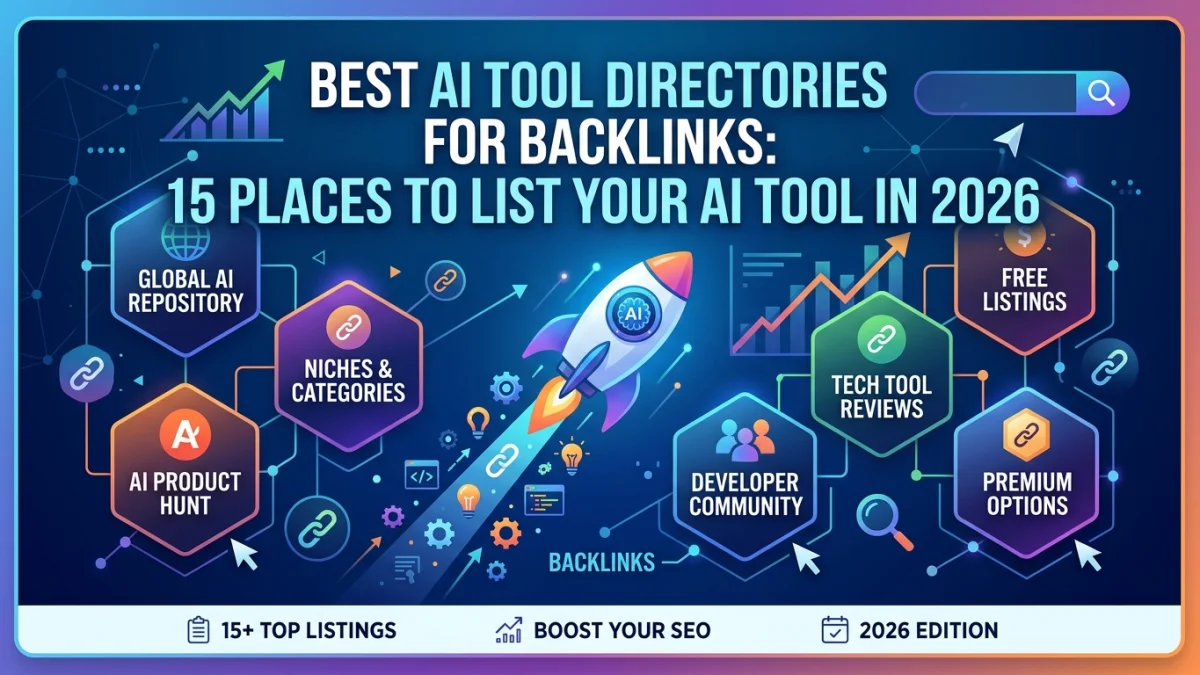
Launching an AI tool is only the first step. The next challenge is getting people to discover it.
With thousands of AI products competing for attention, founders are increasingly using AI tool directories to improve product discovery, build brand visibility, generate referral traffic, and earn relevant links to their websites.
But there is an important distinction between submitting your product to a directory and building a useful backlink profile.
Google’s Search policies specifically identify low-quality directory or bookmark-site links as an example of link spam when they are created primarily to manipulate search rankings. (Google for Developers)
That means the goal shouldn’t be to submit your AI product to hundreds of random directories.
Instead, focus on directories that provide genuine value to users and give your product a relevant place to be discovered.
In this guide, we’ll look at some of the best AI tool directories for backlinks and product discovery in 2026, including free and paid options, what to look for before submitting, and how to use directories as part of a broader SEO strategy.
Quick Answer: What Are the Best AI Tool Directories for Backlinks?
Some AI and software directories worth researching in 2026 include:
- TrustMyTool
- There’s An AI For That
- Toolify
- AIxploria
- Futurepedia
- FutureTools
- The Rundown AI
- TopAI.tools
- AI Agent Store
- Product Hunt
- DirectoryReady
- AIToolsRecap
- LaunchBoosts
- BestAITools
- Other niche SaaS and AI directories
Directory availability, pricing, link attributes, and submission policies can change, so always verify the current terms before submitting.
For example, a September 2026 directory database lists hundreds of AI directories and tracks factors such as submission cost, domain metrics, and estimated traffic. (Best AI Tools)
However, those metrics shouldn’t be treated as guarantees of SEO results.
1. TrustMyTool — Free Tool & SaaS Directory
If you’re looking for a straightforward place to list an AI tool, SaaS product, software product, or online tool, TrustMyTool is a strong starting point.
TrustMyTool is a community-driven tool directory designed to help people discover, compare, and review software. Its listings cover categories such as productivity, developer tools, design, marketing, business software, and other online tools. (Trust My Tool)
Why list your AI tool on TrustMyTool?
A product listing can give your company another online presence where potential users can learn about your product.
Depending on the listing, you can provide information such as:
- Tool name
- Website
- Product description
- Key features
- Use cases
- Pricing
- Categories
- Platforms
- Logo
- Ratings
- User reviews
This is particularly useful for startups because you aren’t simply adding a homepage URL to a generic link page. You can build a more complete product profile.
Free AI tool listing
TrustMyTool allows tool owners to publish their products for free.
That makes it an accessible option for:
- AI startups
- Indie hackers
- SaaS founders
- Developers
- Chrome extension creators
- Productivity tool builders
- Marketing software companies
- Business software companies
You can create your listing and use it as another destination where prospective users can learn about your product.
Reviews can add another layer of discovery
TrustMyTool is also built around ratings and real-user reviews.
That matters because directories are more useful when they help people evaluate software, rather than simply displaying a collection of links.
The platform’s stated mission is to make software discovery easier through transparent information and real-user reviews. (Trust My Tool)
Should you submit your AI tool to TrustMyTool?
If your goal is to establish your product on relevant software discovery platforms, a free TrustMyTool listing is a logical place to start.
Publish your tool on TrustMyTool
2. There’s An AI For That
There’s An AI For That is one of the larger AI-tool discovery platforms.
It focuses heavily on helping users discover AI products for particular tasks, making it different from a traditional company directory.
Current 2026 directory research lists it among the largest AI-tool directories by reported traffic and domain metrics. (Best AI Tools)
For founders, the attraction is obvious: your product can potentially be discovered by people who are already looking for an AI solution.
However, submission pricing and requirements should be checked directly before submitting because directory policies change.
3. Toolify
Toolify is another major AI-tool discovery website.
It organizes AI products into categories and helps users discover different AI solutions.
Current directory research places Toolify among the larger AI directories by reported traffic. (Best AI Tools)
For an AI SaaS founder, Toolify may be worth considering as part of a broader product-distribution strategy.
The important point is to evaluate the listing based on more than its backlink.
Ask:
- Is the listing page indexed?
- Does the directory have real visitors?
- Is your category relevant?
- Can users discover your product?
- What does the submission cost?
- What type of link does the listing provide?
4. AIxploria
AIxploria is another AI-focused directory included in current 2026 directory research.
Its focus on AI tools makes it potentially relevant for software companies building AI-powered products.
A current directory database reports significant traffic to the platform, although traffic estimates from third-party databases should always be treated as estimates rather than guaranteed figures. (Best AI Tools)
Before submitting, check the current submission process and whether your product fits its categories.
5. Futurepedia
Futurepedia is a well-known AI discovery and education platform.
It combines AI-tool discovery with educational content, which can make it different from a basic directory.
Current 2026 directory research includes Futurepedia among established AI-tool directories. (Best AI Tools)
For founders, the key consideration is whether the potential exposure justifies the current submission requirements or cost.
Don’t submit simply because a directory has a high domain metric.
6. FutureTools
FutureTools is another established AI-tool discovery website.
It is included in current directory research and is particularly relevant to products positioned specifically as AI tools. (Best AI Tools)
If your product has a clear AI use case, it can be worth investigating as part of your distribution strategy.
7. The Rundown AI
The Rundown AI also has an AI tools section where users can discover AI products.
It appears in current AI-directory databases alongside other established platforms. (Best AI Tools)
For AI startups, this type of specialized discovery platform can potentially provide another route to reach people already interested in AI software.
8. TopAI.tools
TopAI.tools is another AI-tool discovery platform that appears in current directory research.
The site focuses on helping users find AI products across different categories.
When evaluating directories like this, look beyond the advertised domain authority.
Consider whether your product gets:
- A dedicated listing
- Relevant categorization
- Search visibility
- Referral opportunities
- Product information
- User discovery
9. AI Agent Store
If your product is specifically an AI agent, AI-agent directory platforms can be particularly relevant.
AI Agent Store is included among current AI-directory databases. (Best AI Tools)
Niche relevance can be valuable because visitors are already looking for the type of product you provide.
A smaller, highly relevant directory may be more useful for your business than a much larger directory where your product is buried among thousands of unrelated listings.
10. Product Hunt
Product Hunt is not exclusively an AI directory, but it is highly relevant for launching software products.
It can be useful when your objective is broader than SEO.
A Product Hunt launch can potentially help with:
- Product discovery
- Community feedback
- Brand awareness
- Launch exposure
- Customer conversations
- Startup visibility
Current directory research also includes Product Hunt among platforms founders can consider for AI-product distribution. (Verified Tools)
Don’t approach Product Hunt purely as a backlink-building exercise. Its primary value is product discovery and launch exposure.
11. DirectoryReady
DirectoryReady is another directory focused on helping founders submit AI products.
Its current guide emphasizes relevance, traffic, and potential visibility in AI-generated search experiences rather than simply focusing on traditional backlink metrics. (DirectoryReady)
This reflects an important change in how founders should think about directory submissions.
The question isn’t simply:
“Does this website give me a backlink?”
A better question is:
“Can this listing help people discover my product?”
12. AIToolsRecap
AIToolsRecap is another directory included in recent 2026 research into AI-tool submission sites.
A recent comparison examines factors such as free submission availability, link attributes, paid options, and AI-engine citations. (Verified Tools)
Those measurements are useful for research, but remember that third-party metrics can change quickly.
Always verify the current submission terms yourself.
13. LaunchBoosts
LaunchBoosts is another platform focused on startup and AI-product discovery.
Its 2026 research highlights three useful factors when evaluating directories:
- Link type
- Traffic quality
- Indexation
Those are sensible criteria for evaluating any directory. (LaunchBoosts)
A directory doesn’t become valuable simply because it offers a “dofollow” link.
A relevant directory with real users can provide value through discovery even when the link itself isn’t a traditional followed backlink.
14. BestAITools
BestAITools maintains a large database of AI-tool directories.
Its September 2026 directory database reports hundreds of directories and provides information such as estimated traffic, domain metrics, and submission costs. (Best AI Tools)
This type of resource can be useful if you’re building a list of potential submission opportunities.
However, avoid submitting blindly to every directory in a large database.
Quality matters more than quantity.
15. Niche SaaS and Industry Directories
Don’t limit your strategy to AI directories.
Suppose you’re building:
- AI SEO software
- AI writing software
- AI coding tools
- AI video software
- AI design software
- AI sales tools
- AI marketing platforms
- AI customer-support software
In that case, look for directories specifically focused on your industry.
For example, an AI sales platform may benefit from appearing in a sales-software directory in addition to an AI directory.
A developer-focused AI product may be more relevant to developer-tool directories.
Relevance is often more useful than simply chasing a high domain metric.
AI Tool Directory Comparison
Here’s a practical way to think about the directories discussed above:
|
Directory |
Main purpose |
Best suited for |
|---|---|---|
|
TrustMyTool |
Tool discovery, reviews & listings |
AI, SaaS & software |
|
There’s An AI For That |
AI discovery |
AI products |
|
Toolify |
AI tool discovery |
AI startups |
|
AIxploria |
AI discovery |
AI tools |
|
Futurepedia |
AI discovery & education |
AI products |
|
FutureTools |
AI tool discovery |
AI software |
|
The Rundown AI |
AI discovery |
AI products |
|
TopAI.tools |
AI discovery |
AI tools |
|
AI Agent Store |
Agent discovery |
AI agents |
|
Product Hunt |
Product launches |
Startups & SaaS |
|
DirectoryReady |
AI product listings |
AI startups |
|
AIToolsRecap |
AI directory |
AI products |
|
LaunchBoosts |
Startup/product discovery |
SaaS & AI |
|
BestAITools |
Directory research |
AI founders |
|
Niche directories |
Industry discovery |
Specialized products |
This isn’t a ranking. Directory policies, traffic, indexing, pricing, and usefulness change over time, so treat this as a starting point for research rather than a permanent hierarchy.
What Makes a Good AI Directory Backlink?
If you’re specifically searching for AI tool directories for backlinks, there are several things you should investigate.
1. Topical relevance
Is the website actually about AI, software, SaaS, technology, or your industry?
A relevant link generally makes more sense than a link from an unrelated website.
2. Dedicated product pages
Does your product receive its own page?
A dedicated page can give visitors more information and provide a better discovery experience.
3. Indexability
Can search engines access and index the listing?
A backlink on a page that isn’t accessible to search engines may not provide the result you expect.
4. Real users
Does the directory appear to have an active audience?
Look for:
- Recent listings
- Recent reviews
- Active categories
- Search functionality
- Updated content
- Social activity
- Organic search presence
5. Useful product information
Good directories allow you to explain what your product actually does.
The more useful the listing, the more likely it is to help users make a decision.
6. Transparent policies
Be cautious with directories that make unrealistic SEO promises.
No legitimate directory can guarantee that one backlink will make your website rank.
Dofollow vs. Nofollow: Does It Matter?
This is one of the most common questions about directory backlinks.
A dofollow link can generally be crawled and may be considered among the signals Google uses to understand web pages.
A nofollow link tells search engines that the site doesn’t want to pass the same ranking endorsement associated with a normal followed link.
But that doesn’t mean a nofollow link is useless.
It can still generate:
- Referral traffic
- Brand exposure
- Product discovery
- Potential customers
- Secondary mentions
Google itself emphasizes that links can be valuable when they are deserved and warns against methods designed primarily to manipulate rankings. (Google for Developers)
Therefore, don’t reject a useful directory simply because its listing link isn’t followed.
Are AI Directory Backlinks Safe for SEO?
They can be, but the way you acquire and use them matters.
Google’s current spam policies explicitly identify low-quality directory or bookmark-site links as an example of link spam. The policy also addresses automated link creation, excessive link exchanges, paid links intended to manipulate rankings, and other forms of artificial link building. (Google for Developers)
That doesn’t mean every directory listing is bad.
A genuine product directory can be useful when it exists to help people discover software.
The distinction is purpose and quality.
A useful directory listing:
- Describes a real product
- Helps users discover software
- Provides meaningful product information
- Is relevant to the directory’s audience
- Exists independently of your SEO campaign
A low-quality directory listing:
- Exists primarily to sell links
- Contains thousands of unrelated websites
- Has little useful content
- Uses automatically generated pages
- Exists mainly to manipulate search rankings
The second type is what you want to avoid.
How to Submit Your AI Tool to Directories
Don’t simply copy your homepage description into every submission form.
Instead, prepare a reusable submission package.
Your AI directory submission checklist
Product name
Use your actual brand/product name.
Short description
Prepare a 50–100 word description explaining the product.
Long description
Prepare a more detailed 200–500 word version.
Website URL
Use the most relevant landing page rather than automatically linking to your homepage.
Category
Select the most specific category available.
Key features
Prepare 5–10 concise feature descriptions.
Use cases
Explain the problems your product solves.
Pricing
Clearly state whether your product is:
- Free
- Freemium
- Subscription
- One-time purchase
- Usage-based
Logo
Use a clean, recognizable logo.
Screenshots
Use real screenshots when the directory supports them.
Social profiles
Add your official social accounts where appropriate.
Don’t Use the Same Description Everywhere
This is an underrated part of directory SEO.
If you submit exactly the same description to dozens of websites, you aren’t giving each directory’s visitors the best possible information.
Instead, create several variations.
For example:
Version A: Product-focused
Explain exactly what the software does.
Version B: Problem-focused
Explain the problem your product solves.
Version C: Audience-focused
Explain who benefits from the product.
This doesn’t mean you should artificially rewrite content simply to create search-engine pages. The goal is to provide genuinely useful information to each directory’s audience.
Google’s spam policies also caution against creating large amounts of low-value content primarily to manipulate search rankings. (Google for Developers)
How Many AI Directories Should You Submit To?
There isn’t a magic number.
Submitting to 10 relevant directories can be more useful than submitting to 300 low-quality websites.
A practical approach is:
Phase 1: Start with 5–10 relevant directories
Choose platforms where your product genuinely fits.
Phase 2: Add niche directories
Find directories related specifically to your product category.
Phase 3: Build editorial links
Work toward:
- Product reviews
- Tutorials
- Case studies
- Guest contributions
- Interviews
- Founder stories
- Industry articles
Phase 4: Earn natural mentions
Create something worth referencing.
For example:
- Free tools
- Original research
- Industry statistics
- Open-source projects
- Useful templates
- Public datasets
- Detailed tutorials
Directories should be one part of your SEO strategy, not the entire strategy.
How to Get More Value From a TrustMyTool Listing
If you’re using TrustMyTool, don’t treat the listing as a simple backlink submission.
Build a complete product profile.
Include:
A clear product description
Tell visitors exactly what the tool does.
Key features
Highlight the functionality that differentiates the product.
Use cases
Explain the situations where your product is useful.
Pricing
Make pricing information easy to understand.
Platforms
Mention whether the product works on:
- Web
- Chrome
- Windows
- macOS
- Android
- iOS
- Other platforms
Reviews
Encourage genuine users to share honest experiences where appropriate.
Product branding
Use a recognizable logo and accurate company information.
The objective is to make your TrustMyTool page useful enough that someone discovering it doesn’t need to immediately leave the directory to understand what your product offers.
TrustMyTool for AI and SaaS Founders
One reason directory listings can be useful for startups is that a young website often doesn’t have many external mentions.
A new SaaS website might have:
- A homepage
- A few product pages
- Social profiles
- Some early customers
- Very few external references
A product directory creates another place where your product can be discovered.
TrustMyTool is designed around this type of software discovery, with listings covering different categories of tools and a focus on user reviews and transparent product information. (Trust My Tool)
For founders looking for a free AI tool directory, that makes it worth considering as part of an early distribution strategy.
List your AI or SaaS product on TrustMyTool
Backlinks Are Not the Only Goal
This is perhaps the most important point in this entire article.
If you search for:
“best AI tool directories for backlinks”
it’s easy to become obsessed with:
- DA
- DR
- Dofollow
- Anchor text
- Link counts
Those metrics can be useful, but they aren’t the whole picture.
Consider this example.
Directory A
- High domain metric
- Thousands of listings
- Almost no users
- Your product is buried
- Expensive submission
Directory B
- Smaller domain
- Relevant audience
- Active users
- Dedicated product page
- Free submission
- Genuine reviews
Which one creates more business value?
You can’t answer that from domain authority alone.
That’s why relevance, traffic, product discovery, and user value should be part of your evaluation.
AI Directories and AI Search Visibility
AI-powered search is also changing how people discover software.
Search engines and AI systems can use information from many sources when constructing answers.
Some current directory research is specifically examining whether AI engines cite directory pages and whether structured product information can improve discoverability. (Verified Tools)
However, don’t interpret a directory listing as a guarantee that ChatGPT, Google AI features, Claude, Perplexity, or another AI system will mention your product.
There are no guarantees.
The practical takeaway is simpler:
Make your product information easy for both humans and machines to understand.
Clear names, descriptions, categories, features, pricing information, and consistent company information can make your web presence easier to understand.
Common AI Directory Submission Mistakes
Mistake 1: Submitting everywhere
More isn’t automatically better.
Prioritize relevant directories.
Mistake 2: Buying links solely for SEO
Google’s policies specifically address paid links intended to manipulate rankings. (Google for Developers)
Mistake 3: Using keyword-stuffed anchor text
Don’t try to turn every link into:
best AI writing tool cheap AI writing software
Use your actual brand or natural descriptive text.
Mistake 4: Publishing fake reviews
If a directory supports reviews, encourage genuine users to provide honest feedback.
Mistake 5: Ignoring your own website
Directory links won’t fix a poor product website.
Make sure your website has:
- Fast loading pages
- Clear navigation
- Strong product messaging
- Useful content
- Transparent pricing
- Contact information
- Clear calls to action
Mistake 6: Treating domain authority as the only metric
Traffic, relevance, indexation, audience, and product discovery can matter too.
A Simple AI Directory Link-Building Strategy
Here’s a practical workflow for a new AI startup.
Week 1: Prepare
Create:
- Product description
- Feature list
- Use cases
- Logo
- Screenshots
- Pricing information
- Social profiles
Week 2: Submit
Start with relevant free directories, including TrustMyTool.
Then submit to selected established AI directories that fit your product.
Week 3: Build niche presence
Look for directories specifically related to your industry.
Week 4: Create link-worthy content
Publish something genuinely useful:
- Research
- Statistics
- Tutorial
- Free tool
- Template
- Case study
- Comparison
Then promote it.
Ongoing
Monitor:
- Referral traffic
- Search impressions
- New backlinks
- Brand mentions
- Product signups
- Directory traffic
Remove or ignore low-value opportunities instead of endlessly submitting to more sites.
Frequently Asked Questions
What are the best AI tool directories for backlinks?
There are many options, including TrustMyTool, There’s An AI For That, Toolify, AIxploria, Futurepedia, FutureTools, The Rundown AI, TopAI.tools, and other niche AI and SaaS directories.
The best directory for your product depends on relevance, audience, current submission rules, indexing, cost, and the quality of the listing.
Is TrustMyTool free?
TrustMyTool offers free tool publishing. It is designed as a community-driven directory where people can discover, compare, and review software. (Trust My Tool)
Are AI directory backlinks good for SEO?
A relevant directory listing can provide discovery and referral value, but directory backlinks should not be treated as a guaranteed SEO ranking tactic.
Google specifically warns against low-quality directory links created primarily to manipulate rankings. (Google for Developers)
Should I submit my SaaS to AI directories?
If your SaaS genuinely uses AI or belongs to the software categories covered by the directory, relevant submissions can be worthwhile for product discovery and referral opportunities.
Are nofollow directory links useless?
No.
A nofollow link can still send referral traffic, generate brand exposure, and help people discover your product.
How many AI directories should I submit to?
There is no universal number.
Start with a small group of relevant, useful directories and expand into niche directories rather than submitting to hundreds of low-quality sites.
Do AI directories guarantee Google rankings?
No.
No directory should be treated as a guaranteed ranking shortcut.
SEO depends on many factors, including your site’s content, technical quality, relevance, reputation, links, and how users interact with your content.
Can AI directories help with AI search visibility?
They can provide another source of structured information about your product, and current industry research is exploring the role directories play in AI-generated search and citations. (Verified Tools)
But a listing does not guarantee that an AI system will cite or recommend your product.
Final Takeaway
The best way to approach AI tool directories for backlinks is to stop thinking about backlinks alone.
A good directory listing can combine several benefits:
Product discovery + relevant referral traffic + brand visibility + third-party presence + potential SEO value.
For AI and SaaS founders looking for a free place to start, TrustMyTool provides a straightforward option for publishing a product listing and building an additional discovery page for your software.
Publish your AI tool for free on TrustMyTool
From there, expand into established AI directories, niche software directories, launch platforms, and industry-specific communities.
Most importantly, prioritize quality over quantity.
One useful product listing that attracts real visitors is more valuable to your business than dozens of low-quality directory pages created solely to accumulate backlinks.